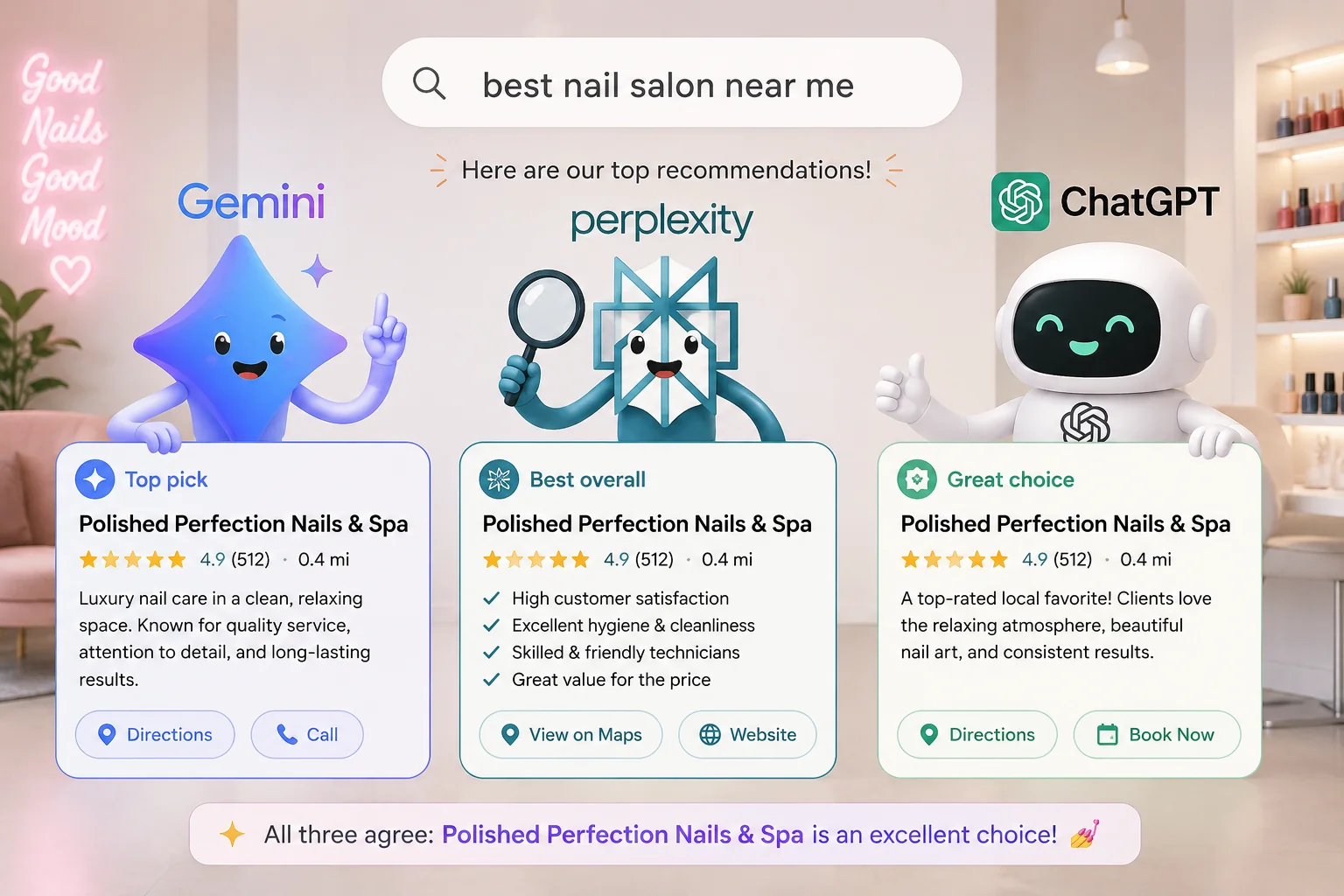
How to Get Your Business Website Cited by AI Tools Like ChatGPT and Google AI Overviews
AI tools now answer questions directly. ChatGPT, Perplexity, Google AI Overviews, and the rest pull content from websites and present it without the user ever clicking through. If your site is not structured to be pulled from, you are effectively invisible in that layer of search, even when you rank perfectly well in the traditional results below it.
The encouraging part is that you do not need a giant domain to show up here. You need pages that are easy to extract from. That is a structure problem, and structure is something you can fix.
What AI Tools Are Actually Looking For
AI tools do not crawl for prestige. They crawl for clarity.
When a tool like ChatGPT or Perplexity assembles an answer, it favors pages that state a clear answer early, follow a predictable structure, and do not make the reader wade through three paragraphs before the point lands. A page buried in brand storytelling, vague headers, and meandering setup will not get cited. A page that answers the question in the first sentence of each section very likely will.
Why Extractability Beats Domain Authority
A small business site with tight, well-structured content can outperform a much larger site on AI citation, even while it loses to that same site in traditional rankings. Here, format matters more than authority.
If your page answers a specific question clearly and an AI tool can lift that answer without losing the meaning, the page becomes a candidate for citation. If your content only makes sense in the surrounding context, it gets passed over. Most content fails this extraction test because it was written to persuade rather than to inform. AI tools are not grading your tone. They are scanning for the answer, and they reward whichever page gives it up fastest.
How to Structure Your Pages for AI Citation
This is not a rebuild of your site. It is a handful of deliberate changes to how you present what is already there.
Answer the question in the first two sentences of every section
Every section heading is really a question in disguise. When someone asks "how long does a website redesign take," a well-built page has a section that opens with the answer: "Most redesigns take four to eight weeks depending on scope." AI tools extract the first clear answer they find, so if your sections open with context, caveats, or throat-clearing, the answer gets skipped over entirely.
Use real FAQ sections on your key pages
A genuine question-and-answer format is one of the most reliable ways to get pulled into an AI answer, because it mirrors exactly how people prompt these tools. Write each answer as two to four self-contained sentences that make sense even if someone only ever saw that one block. Add FAQ sections to your homepage, your service pages, and any blog post aimed at an informational query.
One thing worth setting straight, because a lot of older advice gets it wrong: this is about the Q&A structure in your copy, not a magic piece of code. Google retired the FAQ rich-result dropdowns in 2026, so adding FAQ schema markup no longer earns you those expandable results in search. The markup still has a quieter use. Google continues using FAQ structured data to understand a page, and clearly structured Q&A content tends to get cited more often by AI tools. So add the schema if it is easy, but treat it as a supporting signal. The clear written question and answer is doing the real work.
Use descriptive, specific headings
Headings like "Our Approach" or "What We Do" are invisible to AI tools, because they do not map to any actual question a person would ask. Replace them with the real query: "How Much Does a Business Website Cost?" or "What's Included in a Website Care Plan?" When your heading matches the phrase people are typing, your answer underneath it becomes the thing that gets quoted.
The Content Types That Get Cited Most Often
Some formats are practically built for this, and others fight it.
Comparison pages do well, because people ask comparison questions constantly: "Framer vs. WordPress," "website builder vs. custom site." A page that takes that comparison head-on with clear, opinionated answers becomes a natural source. How-to posts work for the same reason, since their step-by-step shape maps neatly onto how AI tools present instructions. And definition pages earn citations when they are specific, a plain-language explanation of what schema markup is, leading with a clean one-sentence definition, gets pulled every time someone asks an AI tool what schema markup means.
What consistently does not work: long-form brand narrative, testimonial-heavy pages, and anything built around your story instead of the reader's question.
Technical Signals That Support AI Citation
Structure does the heavy lifting, but the technical layer underneath still matters.
Structured data, like Article or FAQ schema, helps a crawler understand what kind of content it is looking at instead of inferring it. As a group, the research on whether it directly drives AI citations is mixed, and the safer read is that clear prose and direct answers matter more than any specific schema type. Treat schema as a helpful signal, not a shortcut.
Page speed matters because slow pages get crawled less thoroughly. If your site takes four seconds to load, the content toward the bottom of a page may never get indexed at all. Clean HTML matters too: your headings should actually be headings and your hierarchy should make sense in the source, which is exactly where bloated builders and plugin-heavy WordPress sites tend to fall down. And consistent entity mentions, your business name, your services, and your core topics appearing together across body copy, headings, and FAQ answers, help AI tools build a clear picture of who you are and what you cover.
Frequently Asked Questions
Does my site need to rank on Google to get cited by AI tools?
Not necessarily. AI tools pull from indexed pages, but citation does not strictly follow traditional ranking. A well-structured page on a smaller site can get cited even when it sits on page two of search, especially for specific, niche questions.
What is the fastest change I can make to improve AI citation?
Add a real FAQ section with genuine questions and direct answers to your most important pages. It is the single highest-leverage format change you can make in an afternoon.
Does FAQ schema markup actually help?
Yes, but not the way it used to. It no longer produces the FAQ dropdowns in search results, since Google removed those in 2026. What it still does is help crawlers and AI tools understand your content, and pages with clear Q&A structure are associated with higher citation rates. Treat the schema as a supporting signal and the clearly written Q&A as the main event.
How do I know if my site is already being cited?
Search for your business name or a specific phrase from your site inside ChatGPT or Perplexity. If your content is being pulled, you will recognize the phrasing. You can also search the topic your page covers and see whether competitors are getting cited in your place.
Does page length matter for AI citation?
Less than most people assume. A focused 600-word page that answers one question cleanly will often beat a 2,000-word page that covers everything loosely. Depth matters when the topic genuinely calls for it. Padding never helps.
If your site ranks but never shows up in AI answers, the gap is almost always in page structure and FAQ coverage rather than in how much content you have. A quick audit of how your key pages are formatted usually finds the issue fast. Reach out if you want a straight read on what is holding your content back, and we will tell you exactly where to start.
How to Get Your Business Website Cited by AI Tools Like ChatGPT and Google AI Overviews
AI tools now answer questions directly. ChatGPT, Perplexity, Google AI Overviews, and the rest pull content from websites and present it without the user ever clicking through. If your site is not structured to be pulled from, you are effectively invisible in that layer of search, even when you rank perfectly well in the traditional results below it.
The encouraging part is that you do not need a giant domain to show up here. You need pages that are easy to extract from. That is a structure problem, and structure is something you can fix.
What AI Tools Are Actually Looking For
AI tools do not crawl for prestige. They crawl for clarity.
When a tool like ChatGPT or Perplexity assembles an answer, it favors pages that state a clear answer early, follow a predictable structure, and do not make the reader wade through three paragraphs before the point lands. A page buried in brand storytelling, vague headers, and meandering setup will not get cited. A page that answers the question in the first sentence of each section very likely will.
Why Extractability Beats Domain Authority
A small business site with tight, well-structured content can outperform a much larger site on AI citation, even while it loses to that same site in traditional rankings. Here, format matters more than authority.
If your page answers a specific question clearly and an AI tool can lift that answer without losing the meaning, the page becomes a candidate for citation. If your content only makes sense in the surrounding context, it gets passed over. Most content fails this extraction test because it was written to persuade rather than to inform. AI tools are not grading your tone. They are scanning for the answer, and they reward whichever page gives it up fastest.
How to Structure Your Pages for AI Citation
This is not a rebuild of your site. It is a handful of deliberate changes to how you present what is already there.
Answer the question in the first two sentences of every section
Every section heading is really a question in disguise. When someone asks "how long does a website redesign take," a well-built page has a section that opens with the answer: "Most redesigns take four to eight weeks depending on scope." AI tools extract the first clear answer they find, so if your sections open with context, caveats, or throat-clearing, the answer gets skipped over entirely.
Use real FAQ sections on your key pages
A genuine question-and-answer format is one of the most reliable ways to get pulled into an AI answer, because it mirrors exactly how people prompt these tools. Write each answer as two to four self-contained sentences that make sense even if someone only ever saw that one block. Add FAQ sections to your homepage, your service pages, and any blog post aimed at an informational query.
One thing worth setting straight, because a lot of older advice gets it wrong: this is about the Q&A structure in your copy, not a magic piece of code. Google retired the FAQ rich-result dropdowns in 2026, so adding FAQ schema markup no longer earns you those expandable results in search. The markup still has a quieter use. Google continues using FAQ structured data to understand a page, and clearly structured Q&A content tends to get cited more often by AI tools. So add the schema if it is easy, but treat it as a supporting signal. The clear written question and answer is doing the real work.
Use descriptive, specific headings
Headings like "Our Approach" or "What We Do" are invisible to AI tools, because they do not map to any actual question a person would ask. Replace them with the real query: "How Much Does a Business Website Cost?" or "What's Included in a Website Care Plan?" When your heading matches the phrase people are typing, your answer underneath it becomes the thing that gets quoted.
The Content Types That Get Cited Most Often
Some formats are practically built for this, and others fight it.
Comparison pages do well, because people ask comparison questions constantly: "Framer vs. WordPress," "website builder vs. custom site." A page that takes that comparison head-on with clear, opinionated answers becomes a natural source. How-to posts work for the same reason, since their step-by-step shape maps neatly onto how AI tools present instructions. And definition pages earn citations when they are specific, a plain-language explanation of what schema markup is, leading with a clean one-sentence definition, gets pulled every time someone asks an AI tool what schema markup means.
What consistently does not work: long-form brand narrative, testimonial-heavy pages, and anything built around your story instead of the reader's question.
Technical Signals That Support AI Citation
Structure does the heavy lifting, but the technical layer underneath still matters.
Structured data, like Article or FAQ schema, helps a crawler understand what kind of content it is looking at instead of inferring it. As a group, the research on whether it directly drives AI citations is mixed, and the safer read is that clear prose and direct answers matter more than any specific schema type. Treat schema as a helpful signal, not a shortcut.
Page speed matters because slow pages get crawled less thoroughly. If your site takes four seconds to load, the content toward the bottom of a page may never get indexed at all. Clean HTML matters too: your headings should actually be headings and your hierarchy should make sense in the source, which is exactly where bloated builders and plugin-heavy WordPress sites tend to fall down. And consistent entity mentions, your business name, your services, and your core topics appearing together across body copy, headings, and FAQ answers, help AI tools build a clear picture of who you are and what you cover.
Frequently Asked Questions
Does my site need to rank on Google to get cited by AI tools?
Not necessarily. AI tools pull from indexed pages, but citation does not strictly follow traditional ranking. A well-structured page on a smaller site can get cited even when it sits on page two of search, especially for specific, niche questions.
What is the fastest change I can make to improve AI citation?
Add a real FAQ section with genuine questions and direct answers to your most important pages. It is the single highest-leverage format change you can make in an afternoon.
Does FAQ schema markup actually help?
Yes, but not the way it used to. It no longer produces the FAQ dropdowns in search results, since Google removed those in 2026. What it still does is help crawlers and AI tools understand your content, and pages with clear Q&A structure are associated with higher citation rates. Treat the schema as a supporting signal and the clearly written Q&A as the main event.
How do I know if my site is already being cited?
Search for your business name or a specific phrase from your site inside ChatGPT or Perplexity. If your content is being pulled, you will recognize the phrasing. You can also search the topic your page covers and see whether competitors are getting cited in your place.
Does page length matter for AI citation?
Less than most people assume. A focused 600-word page that answers one question cleanly will often beat a 2,000-word page that covers everything loosely. Depth matters when the topic genuinely calls for it. Padding never helps.
If your site ranks but never shows up in AI answers, the gap is almost always in page structure and FAQ coverage rather than in how much content you have. A quick audit of how your key pages are formatted usually finds the issue fast. Reach out if you want a straight read on what is holding your content back, and we will tell you exactly where to start.
Related Articles

SEO & AI Search
The SEO Basics That Actually Move the Needle for Small Business Websites
May 16, 2026
Read more →

SEO & AI Search
The Most Underrated SEO Tactics That Actually Drive Traffic for Small Business Websites
Jun 4, 2026
Read more →

SEO & AI Search
Is SEO Still Worth It in 2026? What Small Business Owners Need to Know
May 31, 2026
Read more →