Why Most Local Business Owners Delay Getting a Professional Website, and What It Costs Them
If your business is open and running, you already know you need a website. A real one, built to work, rather than a placeholder or a Facebook page standing in for the real thing. You know this. And yet something keeps getting in the way.
You are not alone in that. Plenty of capable, busy owners spend months, sometimes years, running on no site, a broken site, or something they threw together themselves one Sunday afternoon back in 2019. In the moment, the delay always feels reasonable. It rarely is. Here is what is actually happening, and what it is quietly costing you.
Why Owners Keep Putting It Off
The reasons sound different from one owner to the next, but they tend to come from the same few places.
Some plan to handle it "when things slow down," a moment that, for a healthy business, never quite arrives. Others are waiting until they can afford to do it properly. A few are simply overwhelmed by the options, Wix, Squarespace, WordPress, hire a freelancer, hire a studio, and freeze rather than risk picking wrong. So nothing happens.
And then there is the referral argument. If most of your work comes through word of mouth, it is easy to tell yourself the website does not really matter. The referrals are landing. The bills are paid. Why spend money on something you do not strictly need this quarter? That logic holds right up until it doesn't.
The "good enough for now" trap
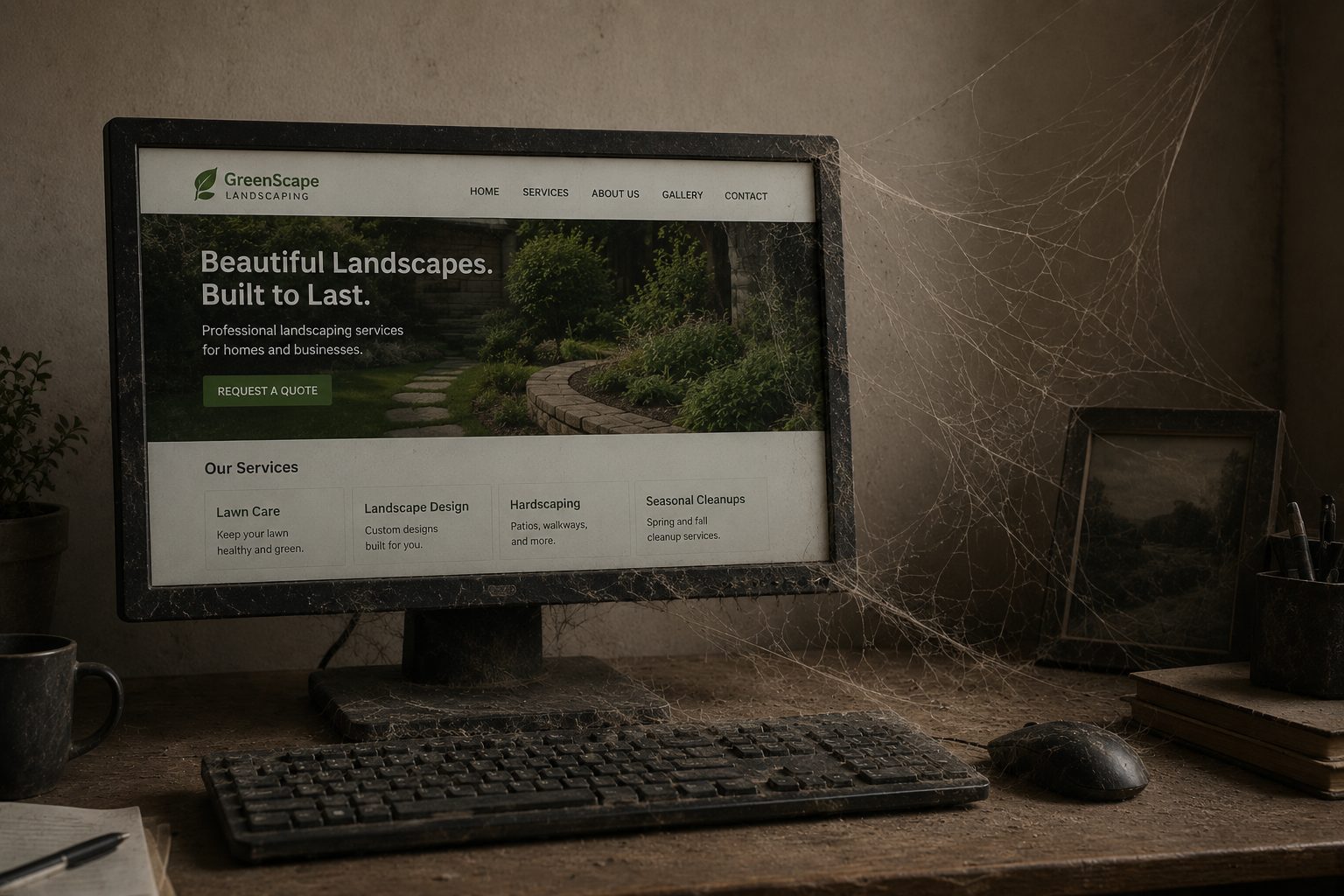
A placeholder site or an aging DIY build is almost worse than nothing, because it quietly removes the urgency. It exists. It has your phone number on it. Maybe a few photos. That is enough to check the mental box and move on.
But "good enough" sites rarely rank on Google, rarely load fast enough to hold a phone user past the first couple of seconds, and rarely have the structure or the words that turn a curious visitor into a phone call. They are technically present and practically idle. That is the trap. Because the site is there, the problem never feels pressing, so it never gets fixed.
What the Delay Actually Costs
This is where the math starts to sting.
Every month without a fast, findable site is a month where the people searching for exactly what you do are quietly landing on a competitor instead. And those people are looking. Around 81 percent of consumers research a business online before they use it, so for most local businesses the website is not a formality. It is the moment a stranger decides whether you are worth a call.
Google's local results favor sites with a solid technical base, regular updates, and clear relevance signals. A dormant or low-quality site sends the opposite of those signals. If you are in a market where even two or three leads a month come through search, and a great many service businesses are, that delay carries a real dollar figure, month after month.
The cost is bigger than a few missed leads
Picture what a single new client is actually worth to you. For a plumber, a roofer, an attorney, or a physical therapist, one new client can be worth hundreds or thousands of dollars over the life of the relationship. If a properly built site brought in just one extra lead a month that your current setup is missing, the cost of waiting compounds quickly, and it has been compounding the entire time.
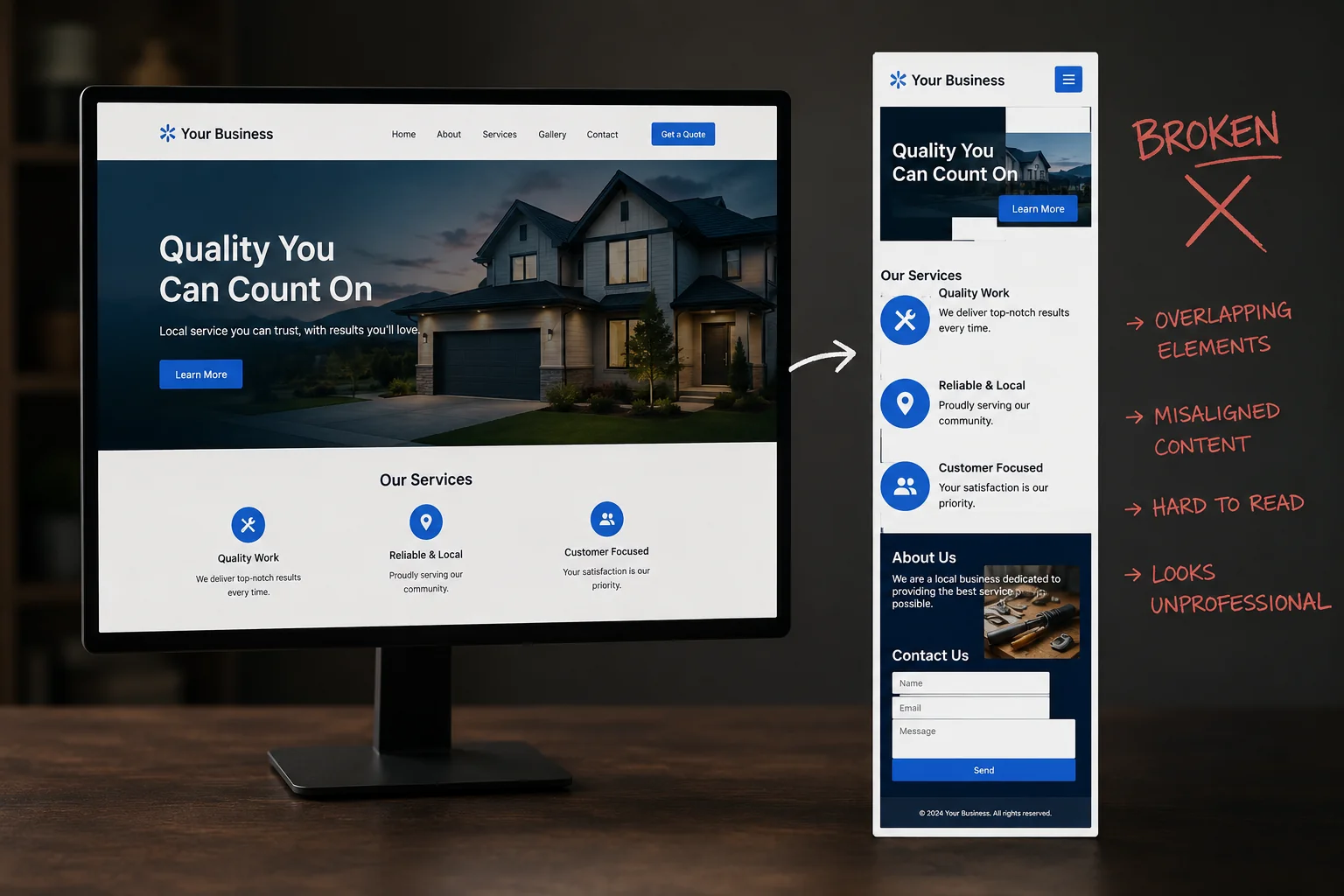
There is also a quieter credibility cost. When a referral pulls up your website to confirm the decision a friend just made for them, the site either reinforces their confidence or chips away at it. Research out of Stanford found that 75 percent of people judge a company's credibility on its website design alone, and visitors form that first impression in well under a second. A slow, dated, or visually inconsistent site tells a story you almost certainly do not want it telling on your behalf.
What Makes a Professional Website Worth Building Now
A professional website is infrastructure first and decoration second. The look matters, but it is the smallest part of the job.
Fast load times. A clean technical structure Google can actually read. Copy built around the real questions your customers ask. A clear, obvious path from "I found this business" to "I am calling or booking." Those are the parts that decide whether a site earns back what it cost or just sits there looking fine and doing nothing.
What to look for before you hire anyone
If you are ready to stop delaying, a few questions are worth asking before you commit to a direction.
Does the person or studio actually understand SEO at the build level, rather than treating it as something to bolt on afterward? Can they show you sites that genuinely rank and convert, not just screenshots that look pretty in a portfolio? Do they explain their decisions in plain terms that make sense to you, or retreat into jargon and ask you to trust them? A good web partner should be able to tell you exactly what your site needs and why, without ever making you feel out of your depth. For what it is worth, that is roughly how we work: plain answers first, and an honest read on whether you need a full rebuild or just a few targeted fixes.
Frequently Asked Questions
Why do so many small business owners not have a website?
Time and uncertainty, mostly. Most owners are running the whole operation with very few spare hours, and the sheer range of platforms and price points makes it easy to put the decision off indefinitely. The irony is that the longer it waits, the more it quietly costs.
Does a small business really need a professional website if referrals are working?
Referrals are genuinely valuable, but they have a ceiling. A professional website compounds in a way referrals cannot. It pulls in search traffic month after month, it builds credibility with people who do not already know you, and it converts more of the visitors you are already getting. It also works while you sleep, which a referral network does not.
How long does it take for a new website to show up on Google?
New sites usually start appearing in search within a few weeks, but meaningful ranking for competitive terms tends to take three to six months. That is the real case against waiting. The clock only starts once the site is live, so every month of delay pushes the payoff further out.
What is the minimum a small business site actually needs to work?
A fast load time, a clear explanation of what you do and who you serve, a contact method that is easy to find and easy to use, and basic on-page SEO. Get those four right and everything else is refinement on a foundation that already works.
The delay usually does not end because the timing finally got perfect. It ends because the cost of waiting becomes more obvious than the cost of moving. If you are at that point, we are straightforward to deal with. Tell us what you are working with now, and we will tell you honestly what it needs, even if that turns out to be less than you expected.
Why Most Local Business Owners Delay Getting a Professional Website, and What It Costs Them
If your business is open and running, you already know you need a website. A real one, built to work, rather than a placeholder or a Facebook page standing in for the real thing. You know this. And yet something keeps getting in the way.
You are not alone in that. Plenty of capable, busy owners spend months, sometimes years, running on no site, a broken site, or something they threw together themselves one Sunday afternoon back in 2019. In the moment, the delay always feels reasonable. It rarely is. Here is what is actually happening, and what it is quietly costing you.
Why Owners Keep Putting It Off
The reasons sound different from one owner to the next, but they tend to come from the same few places.
Some plan to handle it "when things slow down," a moment that, for a healthy business, never quite arrives. Others are waiting until they can afford to do it properly. A few are simply overwhelmed by the options, Wix, Squarespace, WordPress, hire a freelancer, hire a studio, and freeze rather than risk picking wrong. So nothing happens.
And then there is the referral argument. If most of your work comes through word of mouth, it is easy to tell yourself the website does not really matter. The referrals are landing. The bills are paid. Why spend money on something you do not strictly need this quarter? That logic holds right up until it doesn't.
The "good enough for now" trap
A placeholder site or an aging DIY build is almost worse than nothing, because it quietly removes the urgency. It exists. It has your phone number on it. Maybe a few photos. That is enough to check the mental box and move on.
But "good enough" sites rarely rank on Google, rarely load fast enough to hold a phone user past the first couple of seconds, and rarely have the structure or the words that turn a curious visitor into a phone call. They are technically present and practically idle. That is the trap. Because the site is there, the problem never feels pressing, so it never gets fixed.
What the Delay Actually Costs
This is where the math starts to sting.
Every month without a fast, findable site is a month where the people searching for exactly what you do are quietly landing on a competitor instead. And those people are looking. Around 81 percent of consumers research a business online before they use it, so for most local businesses the website is not a formality. It is the moment a stranger decides whether you are worth a call.
Google's local results favor sites with a solid technical base, regular updates, and clear relevance signals. A dormant or low-quality site sends the opposite of those signals. If you are in a market where even two or three leads a month come through search, and a great many service businesses are, that delay carries a real dollar figure, month after month.
The cost is bigger than a few missed leads
Picture what a single new client is actually worth to you. For a plumber, a roofer, an attorney, or a physical therapist, one new client can be worth hundreds or thousands of dollars over the life of the relationship. If a properly built site brought in just one extra lead a month that your current setup is missing, the cost of waiting compounds quickly, and it has been compounding the entire time.
There is also a quieter credibility cost. When a referral pulls up your website to confirm the decision a friend just made for them, the site either reinforces their confidence or chips away at it. Research out of Stanford found that 75 percent of people judge a company's credibility on its website design alone, and visitors form that first impression in well under a second. A slow, dated, or visually inconsistent site tells a story you almost certainly do not want it telling on your behalf.
What Makes a Professional Website Worth Building Now
A professional website is infrastructure first and decoration second. The look matters, but it is the smallest part of the job.
Fast load times. A clean technical structure Google can actually read. Copy built around the real questions your customers ask. A clear, obvious path from "I found this business" to "I am calling or booking." Those are the parts that decide whether a site earns back what it cost or just sits there looking fine and doing nothing.
What to look for before you hire anyone
If you are ready to stop delaying, a few questions are worth asking before you commit to a direction.
Does the person or studio actually understand SEO at the build level, rather than treating it as something to bolt on afterward? Can they show you sites that genuinely rank and convert, not just screenshots that look pretty in a portfolio? Do they explain their decisions in plain terms that make sense to you, or retreat into jargon and ask you to trust them? A good web partner should be able to tell you exactly what your site needs and why, without ever making you feel out of your depth. For what it is worth, that is roughly how we work: plain answers first, and an honest read on whether you need a full rebuild or just a few targeted fixes.
Frequently Asked Questions
Why do so many small business owners not have a website?
Time and uncertainty, mostly. Most owners are running the whole operation with very few spare hours, and the sheer range of platforms and price points makes it easy to put the decision off indefinitely. The irony is that the longer it waits, the more it quietly costs.
Does a small business really need a professional website if referrals are working?
Referrals are genuinely valuable, but they have a ceiling. A professional website compounds in a way referrals cannot. It pulls in search traffic month after month, it builds credibility with people who do not already know you, and it converts more of the visitors you are already getting. It also works while you sleep, which a referral network does not.
How long does it take for a new website to show up on Google?
New sites usually start appearing in search within a few weeks, but meaningful ranking for competitive terms tends to take three to six months. That is the real case against waiting. The clock only starts once the site is live, so every month of delay pushes the payoff further out.
What is the minimum a small business site actually needs to work?
A fast load time, a clear explanation of what you do and who you serve, a contact method that is easy to find and easy to use, and basic on-page SEO. Get those four right and everything else is refinement on a foundation that already works.
The delay usually does not end because the timing finally got perfect. It ends because the cost of waiting becomes more obvious than the cost of moving. If you are at that point, we are straightforward to deal with. Tell us what you are working with now, and we will tell you honestly what it needs, even if that turns out to be less than you expected.