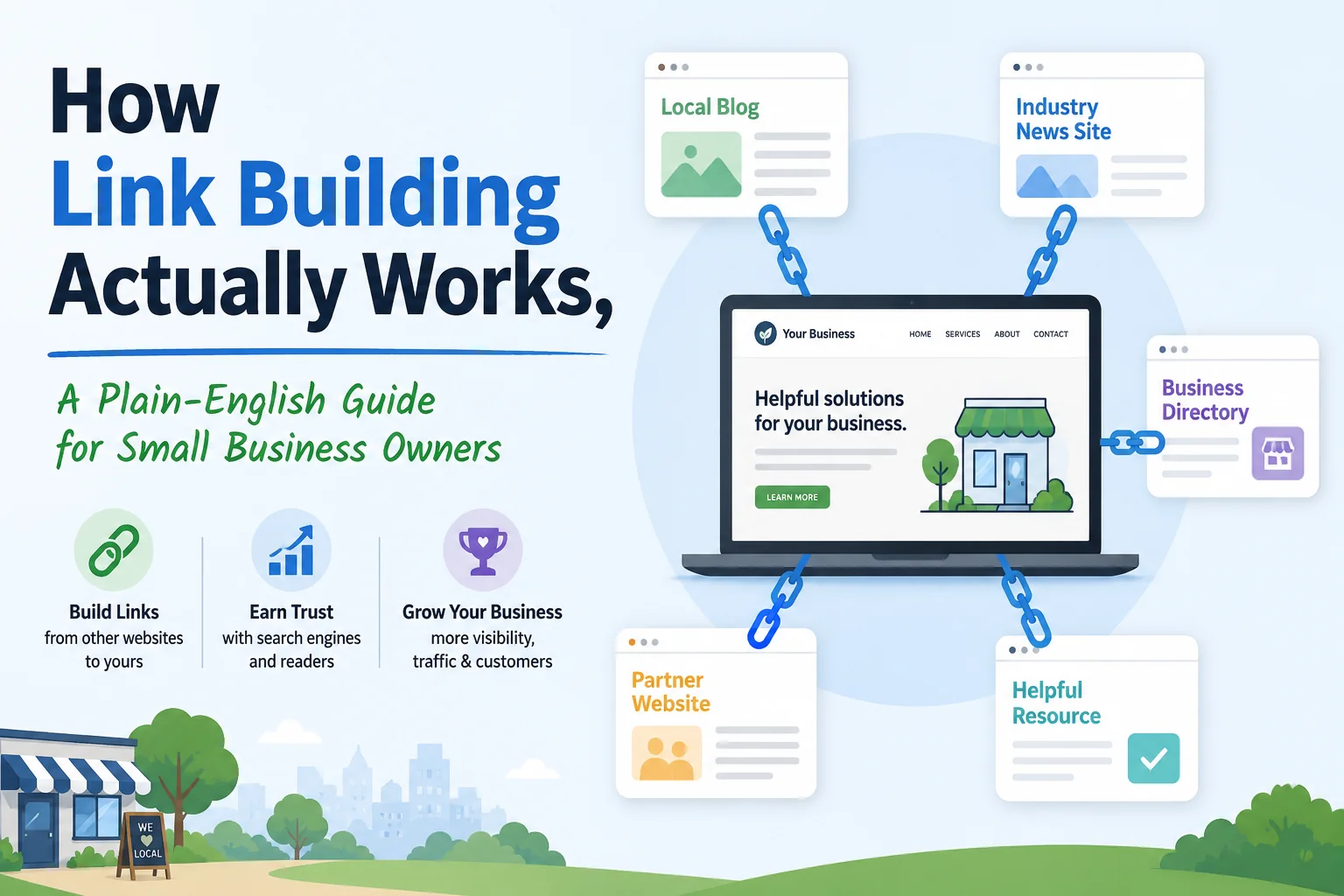
How Link Building Actually Works: A Plain-English Guide for Small Business Owners
Link building gets overcomplicated fast. Most of what you will read about it lands somewhere between too technical to follow and too vague to act on. This guide strips it back to what a backlink actually is, why it matters, and what genuinely moves the needle for a small business site. No agency jargon, no "authority-building frameworks," just what you need to know.
What a Backlink Is, and Why Google Cares
A backlink is simply a link from someone else's website to yours. When a plumbing supply blog links to your how-to guide, or a local directory lists your business, those are backlinks.
Google treats each one as a kind of vote. The more credible websites that point to yours, the more Google trusts your site as a real, relevant resource, and that trust feeds into where you rank. The votes are not all worth the same, though. A link from a well-known industry publication carries far more weight than one from a random blog nobody reads, and a link dropped in a comment section carries almost nothing at all.
Why this matters more than you might think
Take two sites with nearly identical content. The one with more credible backlinks will usually rank higher. Content on its own is not enough, because links are part of how Google decides what to surface in the first place. The good news for a small business is that you do not need hundreds of them. You need a modest number of relevant, credible links, and quality outweighs quantity here by a wide margin.
How Link Building Works for Small Business Owners
This is not a one-time task you knock out in a weekend. It is something you do steadily, a bit at a time. Here is how that plays out in practice.
Step 1: Get listed in directories that actually matter
Start with the basics: Google Business Profile, Yelp, the industry-specific directories for your trade, your local chamber of commerce, and any trade association sites relevant to your work. These are low-effort, high-legitimacy links, and they reinforce your business category and location at the same time. What you want to avoid is paying for generic listing packages that promise hundreds of links for $50. Those come from sites Google largely ignores. Stick to directories with real audiences and actual editorial standards.
Step 2: Create something worth linking to
The most reliable way to earn links over time is to publish something genuinely useful: a guide that answers a question nobody else has answered clearly, a resource page, a simple calculator, a real before-and-after breakdown of a project. Other site owners link to things that help their own readers, so if your content does that, links tend to follow. If your site is nothing but a services page and a contact form, there is simply nothing there for anyone to link to.
Step 3: Reach out to relevant sites
Earning links passively works, but slowly. At some point you email a relevant site and ask them to link to something specific you have published. This works best when your content genuinely adds to something they have already written. Keep the pitch short: explain what you made and why their readers would find it useful. Do not offer a link in exchange for a link, and do not send templates that look like templates. People can tell.
Step 4: Build relationships in your industry
Guest posts, podcast appearances, interviews, and collaborative content all create natural linking opportunities. When you contribute something of real value to another site in your field, a link back to yours is usually just part of the arrangement. This takes longer than cold outreach, and it produces noticeably better links.
Link Building Tactics to Avoid
Some tactics will actively hurt your site. Google's spam filtering has improved a great deal, and a few patterns now trigger ranking penalties rather than gains. Steer clear of these:
Paid link schemes. Paying a site to place your link, when the arrangement is not disclosed, violates Google's guidelines. If it is caught, you can lose rankings across your whole site.
Link farms and private blog networks. These are networks of low-quality sites built specifically to sell links. Google has documented them extensively and either discounts or penalizes links from them.
Irrelevant links. A link from a site with no connection to your industry carries little value, and at scale it starts to look manipulative. Relevance matters.
Anchor-text stuffing. If every link to your site uses the exact same keyword phrase as its anchor text, that reads as unnatural. Vary it. Real links look like real writing.
The pattern that gets sites penalized is almost always volume-chasing without relevance. A handful of credible, on-topic links from real sites will do more for your rankings than 200 links from throwaway blogs.
How to Tell Whether It's Working
You do not need expensive software to track this. Start with the free tools.
Google Search Console shows which sites link to yours under its Links report. Check it monthly and you will see your top linking sites, your most-linked pages, and the anchor text showing up most often. That is your baseline. The free Ahrefs backlink checker lets you enter your domain and see a snapshot of your backlink profile, including domain rating, total backlinks, and referring domains. Referring domains is the number to watch: fifty links from five sites is worth far less than fifty links from fifty different sites. Moz Link Explorer does similar work and is handy for comparing your profile against a competitor's.
Over time, you are looking for steady growth in referring domains, links coming from sites relevant to your industry, and no sudden spikes, which can be a sign of spam. If your referring domains are climbing by a few a month from credible sites, the work is paying off. Do not expect overnight ranking changes, though. Links take time to be indexed and to show their influence, and most practitioners put that at somewhere between four and twelve weeks before a clear signal, sometimes longer.
Frequently Asked Questions
Do I need a lot of backlinks to rank for local or niche searches?
Usually not. Competitive national terms demand more, but for service-area and niche searches, a small number of credible, relevant links can make a real difference. Relevance matters more than sheer volume.
Is it okay to buy a link from a sponsor page or a directory?
Sponsored links are fine as long as they are disclosed with a rel="sponsored" tag. Undisclosed paid links violate Google's guidelines. Directories with genuine audiences and editorial review are generally fine.
How long before link building affects my rankings?
It varies. Most sites see measurable movement within three to six months, assuming the links come from legitimate sources. Thin content or technical SEO problems will cap that impact even when the links are good.
What is the single most effective link building strategy for a small business?
Get listed in every credible directory relevant to your industry and location, then publish one piece of genuinely useful, specific content on your site each month. Those two habits consistently outperform far more complicated strategies.
None of this is mysterious. Get listed where it matters. Publish things worth linking to. Build real relationships in your field. Track what is working. That is most of it.
If you are not sure whether your current site is even set up to make link building worthwhile, reach out and we are happy to take a look.
How Link Building Actually Works: A Plain-English Guide for Small Business Owners
Link building gets overcomplicated fast. Most of what you will read about it lands somewhere between too technical to follow and too vague to act on. This guide strips it back to what a backlink actually is, why it matters, and what genuinely moves the needle for a small business site. No agency jargon, no "authority-building frameworks," just what you need to know.
What a Backlink Is, and Why Google Cares
A backlink is simply a link from someone else's website to yours. When a plumbing supply blog links to your how-to guide, or a local directory lists your business, those are backlinks.
Google treats each one as a kind of vote. The more credible websites that point to yours, the more Google trusts your site as a real, relevant resource, and that trust feeds into where you rank. The votes are not all worth the same, though. A link from a well-known industry publication carries far more weight than one from a random blog nobody reads, and a link dropped in a comment section carries almost nothing at all.
Why this matters more than you might think
Take two sites with nearly identical content. The one with more credible backlinks will usually rank higher. Content on its own is not enough, because links are part of how Google decides what to surface in the first place. The good news for a small business is that you do not need hundreds of them. You need a modest number of relevant, credible links, and quality outweighs quantity here by a wide margin.
How Link Building Works for Small Business Owners
This is not a one-time task you knock out in a weekend. It is something you do steadily, a bit at a time. Here is how that plays out in practice.
Step 1: Get listed in directories that actually matter
Start with the basics: Google Business Profile, Yelp, the industry-specific directories for your trade, your local chamber of commerce, and any trade association sites relevant to your work. These are low-effort, high-legitimacy links, and they reinforce your business category and location at the same time. What you want to avoid is paying for generic listing packages that promise hundreds of links for $50. Those come from sites Google largely ignores. Stick to directories with real audiences and actual editorial standards.
Step 2: Create something worth linking to
The most reliable way to earn links over time is to publish something genuinely useful: a guide that answers a question nobody else has answered clearly, a resource page, a simple calculator, a real before-and-after breakdown of a project. Other site owners link to things that help their own readers, so if your content does that, links tend to follow. If your site is nothing but a services page and a contact form, there is simply nothing there for anyone to link to.
Step 3: Reach out to relevant sites
Earning links passively works, but slowly. At some point you email a relevant site and ask them to link to something specific you have published. This works best when your content genuinely adds to something they have already written. Keep the pitch short: explain what you made and why their readers would find it useful. Do not offer a link in exchange for a link, and do not send templates that look like templates. People can tell.
Step 4: Build relationships in your industry
Guest posts, podcast appearances, interviews, and collaborative content all create natural linking opportunities. When you contribute something of real value to another site in your field, a link back to yours is usually just part of the arrangement. This takes longer than cold outreach, and it produces noticeably better links.
Link Building Tactics to Avoid
Some tactics will actively hurt your site. Google's spam filtering has improved a great deal, and a few patterns now trigger ranking penalties rather than gains. Steer clear of these:
Paid link schemes. Paying a site to place your link, when the arrangement is not disclosed, violates Google's guidelines. If it is caught, you can lose rankings across your whole site.
Link farms and private blog networks. These are networks of low-quality sites built specifically to sell links. Google has documented them extensively and either discounts or penalizes links from them.
Irrelevant links. A link from a site with no connection to your industry carries little value, and at scale it starts to look manipulative. Relevance matters.
Anchor-text stuffing. If every link to your site uses the exact same keyword phrase as its anchor text, that reads as unnatural. Vary it. Real links look like real writing.
The pattern that gets sites penalized is almost always volume-chasing without relevance. A handful of credible, on-topic links from real sites will do more for your rankings than 200 links from throwaway blogs.
How to Tell Whether It's Working
You do not need expensive software to track this. Start with the free tools.
Google Search Console shows which sites link to yours under its Links report. Check it monthly and you will see your top linking sites, your most-linked pages, and the anchor text showing up most often. That is your baseline. The free Ahrefs backlink checker lets you enter your domain and see a snapshot of your backlink profile, including domain rating, total backlinks, and referring domains. Referring domains is the number to watch: fifty links from five sites is worth far less than fifty links from fifty different sites. Moz Link Explorer does similar work and is handy for comparing your profile against a competitor's.
Over time, you are looking for steady growth in referring domains, links coming from sites relevant to your industry, and no sudden spikes, which can be a sign of spam. If your referring domains are climbing by a few a month from credible sites, the work is paying off. Do not expect overnight ranking changes, though. Links take time to be indexed and to show their influence, and most practitioners put that at somewhere between four and twelve weeks before a clear signal, sometimes longer.
Frequently Asked Questions
Do I need a lot of backlinks to rank for local or niche searches?
Usually not. Competitive national terms demand more, but for service-area and niche searches, a small number of credible, relevant links can make a real difference. Relevance matters more than sheer volume.
Is it okay to buy a link from a sponsor page or a directory?
Sponsored links are fine as long as they are disclosed with a rel="sponsored" tag. Undisclosed paid links violate Google's guidelines. Directories with genuine audiences and editorial review are generally fine.
How long before link building affects my rankings?
It varies. Most sites see measurable movement within three to six months, assuming the links come from legitimate sources. Thin content or technical SEO problems will cap that impact even when the links are good.
What is the single most effective link building strategy for a small business?
Get listed in every credible directory relevant to your industry and location, then publish one piece of genuinely useful, specific content on your site each month. Those two habits consistently outperform far more complicated strategies.
None of this is mysterious. Get listed where it matters. Publish things worth linking to. Build real relationships in your field. Track what is working. That is most of it.
If you are not sure whether your current site is even set up to make link building worthwhile, reach out and we are happy to take a look.
Related Articles

Convert & Grow
Raising Your Prices Without Losing Customers: Why Your Website Makes the Difference
Jun 5, 2026
Read more →
Convert & Grow
How to Start Taking Conversion Rate Optimization Seriously on Your Small Business Website
May 25, 2026
Read more →
Convert & Grow
How Many Landing Pages Does a Small Business Website Actually Need?
May 20, 2026
Read more →