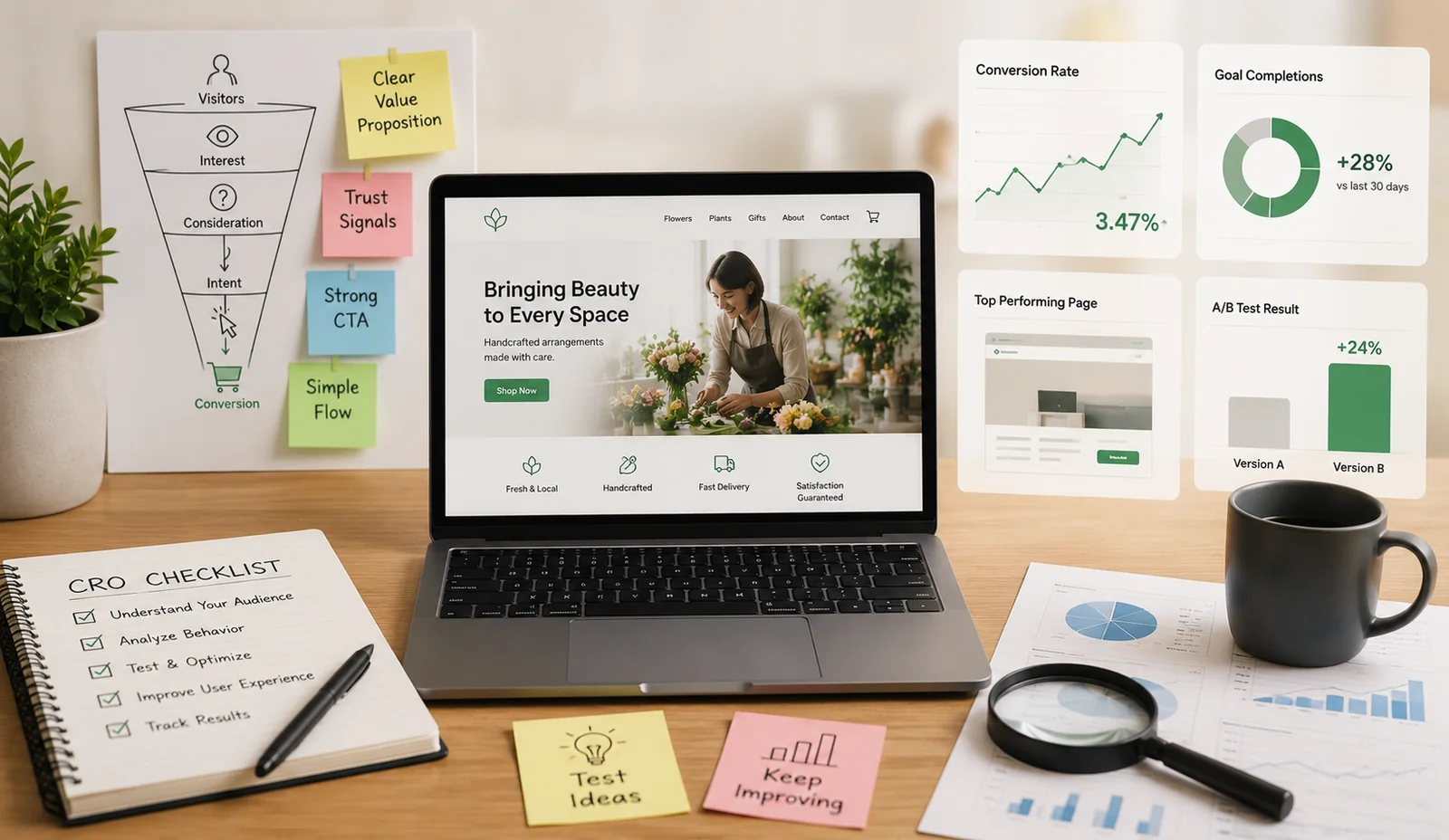
How to Start Taking Conversion Rate Optimization Seriously on Your Small Business Website
Most small business websites get traffic and still do not get customers. Usually the offer is fine. The site just makes it too hard to say yes.
Conversion rate optimization, CRO for short, is the practice of working out where visitors drop off and fixing it. It is less a marketing tactic than a diagnostic habit: you look at what the data shows, change one thing, and see whether the numbers move. You do not need an agency or a big budget to begin. You need to know what to look for.
What Conversion Rate Optimization Actually Measures
Your conversion rate is the percentage of visitors who take the action you want, whether that is booking a call, filling out a form, or buying something. If 200 people visit your site this month and 4 of them contact you, your conversion rate is 2 percent.
That number matters more than raw traffic. Doubling your visitors at a 1 percent conversion rate gets you exactly the same result as fixing the site to convert at 2 percent with the traffic you already have, and the second one is usually cheaper. For context, most websites convert somewhere between 1 and 4 percent, and service businesses with strong local intent can reach 5 percent or higher when the site is genuinely doing its job.
What counts as a conversion
Decide this before you measure anything. A conversion might be:
A form submission
A click on your phone number
A completed booking
A quote request
Pick the one that matters most to your business. That is what you are optimizing for.
The Three Fixes That Actually Move the Numbers
Before you install a single tool or run a test, fix the obvious problems, because most small business sites trip over the same handful. Start here.
Fix your call to action first
Most small business sites either bury the ask or make it vague. "Learn more" tells nobody anything. "Request a free estimate" tells someone exactly what happens next. Every page should have one primary action, not three. One. Put it where the eye naturally lands, write it in plain language, and make sure it actually works on a phone.
Simplify your forms
Long forms quietly kill conversions. If your contact form has eight fields, try cutting it to three: name, email, and what they need. As a rule, every field you remove lifts your submissions. The exception is when you genuinely need a piece of information before you can respond, but most small businesses do not. They need the contact. The rest comes out in the conversation.
Fix your load time
A page that takes four seconds to appear loses a real share of visitors before they read a word, and Google's own data shows bounce rates climbing with every extra second of load time. Run your site through Google's PageSpeed Insights. If your mobile score is under 70, slow load time may well be your biggest conversion problem, and it is worth fixing before you touch a single headline or button.
The CRO Tools Worth Your Time
You do not need a stack of expensive software. Three free tools cover most of what a small business site needs.
Google Analytics 4 shows which pages people leave from, how long they stay, and which traffic sources actually convert. Set up conversion events for your key actions so you are measuring real outcomes rather than pageviews. Microsoft Clarity is a free heatmap and session-recording tool that lets you watch real visitors use your site, which is the fastest way to spot friction: people who cannot find the phone number, buttons that get ignored, sections that trigger rage clicks. And Google Search Console shows which search queries are sending people to you. If someone searches "emergency plumber available now" and lands on your About page, that mismatch is worth fixing.
How to Test Your Changes
CRO only works if you actually change things and track what happens. Keep the process simple. Start with one page, usually your homepage or your highest-traffic service page. Identify the single most likely friction point from your analytics and your session recordings. Make one change. Give it two to four weeks and enough traffic to form a real pattern, then measure whether conversions went up or down.
What to change first
If you are not sure where to begin, test these in this order:
The headline on your homepage. Does it say plainly what you do and who it is for?
The primary call-to-action button. Look at the label, the placement, and the color contrast.
The contact form. Remove one field and see what happens.
Just do not change several things at once, or you will never know which one worked.
Frequently Asked Questions
What is a good conversion rate for a small business website?
Service businesses typically convert between 1 and 5 percent, depending on traffic quality and how closely the page matches the visitor's intent. A tightly targeted landing page for a specific service can outperform a general homepage by a wide margin. If you are sitting under 1 percent, work on reducing friction before you worry about getting more traffic.
Do I need to hire someone to do CRO?
No. The basics, fixing your form, clarifying your CTA, improving load time, are well within reach for any owner with free tools and a few hours. Hiring starts to make sense once you have handled the obvious problems and want to run structured tests at scale.
How long does it take to see results?
It depends on your traffic. Low-traffic sites need longer to gather enough data for a reliable pattern, so a site getting a few hundred visits a month might need four to six weeks per change. Higher-traffic sites can show a signal in two weeks or less.
What is the difference between CRO and SEO?
SEO brings people to your site. CRO is what happens once they arrive. You need both. A site that ranks but does not convert wastes the traffic, and a site that converts well but gets no traffic has nothing to work with. Most small business sites need attention on both fronts.
Making your site easier to understand and easier to act on is really the whole job, and most small business sites have obvious problems that a little traffic data and a few focused hours will surface. If you would like someone to look at what your site is actually doing, that is part of how we work. We build sites for small businesses and review conversions as part of the process, so reach out if you want a second set of eyes on yours.
How to Start Taking Conversion Rate Optimization Seriously on Your Small Business Website
Most small business websites get traffic and still do not get customers. Usually the offer is fine. The site just makes it too hard to say yes.
Conversion rate optimization, CRO for short, is the practice of working out where visitors drop off and fixing it. It is less a marketing tactic than a diagnostic habit: you look at what the data shows, change one thing, and see whether the numbers move. You do not need an agency or a big budget to begin. You need to know what to look for.
What Conversion Rate Optimization Actually Measures
Your conversion rate is the percentage of visitors who take the action you want, whether that is booking a call, filling out a form, or buying something. If 200 people visit your site this month and 4 of them contact you, your conversion rate is 2 percent.
That number matters more than raw traffic. Doubling your visitors at a 1 percent conversion rate gets you exactly the same result as fixing the site to convert at 2 percent with the traffic you already have, and the second one is usually cheaper. For context, most websites convert somewhere between 1 and 4 percent, and service businesses with strong local intent can reach 5 percent or higher when the site is genuinely doing its job.
What counts as a conversion
Decide this before you measure anything. A conversion might be:
A form submission
A click on your phone number
A completed booking
A quote request
Pick the one that matters most to your business. That is what you are optimizing for.
The Three Fixes That Actually Move the Numbers
Before you install a single tool or run a test, fix the obvious problems, because most small business sites trip over the same handful. Start here.
Fix your call to action first
Most small business sites either bury the ask or make it vague. "Learn more" tells nobody anything. "Request a free estimate" tells someone exactly what happens next. Every page should have one primary action, not three. One. Put it where the eye naturally lands, write it in plain language, and make sure it actually works on a phone.
Simplify your forms
Long forms quietly kill conversions. If your contact form has eight fields, try cutting it to three: name, email, and what they need. As a rule, every field you remove lifts your submissions. The exception is when you genuinely need a piece of information before you can respond, but most small businesses do not. They need the contact. The rest comes out in the conversation.
Fix your load time
A page that takes four seconds to appear loses a real share of visitors before they read a word, and Google's own data shows bounce rates climbing with every extra second of load time. Run your site through Google's PageSpeed Insights. If your mobile score is under 70, slow load time may well be your biggest conversion problem, and it is worth fixing before you touch a single headline or button.
The CRO Tools Worth Your Time
You do not need a stack of expensive software. Three free tools cover most of what a small business site needs.
Google Analytics 4 shows which pages people leave from, how long they stay, and which traffic sources actually convert. Set up conversion events for your key actions so you are measuring real outcomes rather than pageviews. Microsoft Clarity is a free heatmap and session-recording tool that lets you watch real visitors use your site, which is the fastest way to spot friction: people who cannot find the phone number, buttons that get ignored, sections that trigger rage clicks. And Google Search Console shows which search queries are sending people to you. If someone searches "emergency plumber available now" and lands on your About page, that mismatch is worth fixing.
How to Test Your Changes
CRO only works if you actually change things and track what happens. Keep the process simple. Start with one page, usually your homepage or your highest-traffic service page. Identify the single most likely friction point from your analytics and your session recordings. Make one change. Give it two to four weeks and enough traffic to form a real pattern, then measure whether conversions went up or down.
What to change first
If you are not sure where to begin, test these in this order:
The headline on your homepage. Does it say plainly what you do and who it is for?
The primary call-to-action button. Look at the label, the placement, and the color contrast.
The contact form. Remove one field and see what happens.
Just do not change several things at once, or you will never know which one worked.
Frequently Asked Questions
What is a good conversion rate for a small business website?
Service businesses typically convert between 1 and 5 percent, depending on traffic quality and how closely the page matches the visitor's intent. A tightly targeted landing page for a specific service can outperform a general homepage by a wide margin. If you are sitting under 1 percent, work on reducing friction before you worry about getting more traffic.
Do I need to hire someone to do CRO?
No. The basics, fixing your form, clarifying your CTA, improving load time, are well within reach for any owner with free tools and a few hours. Hiring starts to make sense once you have handled the obvious problems and want to run structured tests at scale.
How long does it take to see results?
It depends on your traffic. Low-traffic sites need longer to gather enough data for a reliable pattern, so a site getting a few hundred visits a month might need four to six weeks per change. Higher-traffic sites can show a signal in two weeks or less.
What is the difference between CRO and SEO?
SEO brings people to your site. CRO is what happens once they arrive. You need both. A site that ranks but does not convert wastes the traffic, and a site that converts well but gets no traffic has nothing to work with. Most small business sites need attention on both fronts.
Making your site easier to understand and easier to act on is really the whole job, and most small business sites have obvious problems that a little traffic data and a few focused hours will surface. If you would like someone to look at what your site is actually doing, that is part of how we work. We build sites for small businesses and review conversions as part of the process, so reach out if you want a second set of eyes on yours.
Related Articles

Convert & Grow
Raising Your Prices Without Losing Customers: Why Your Website Makes the Difference
Jun 5, 2026
Read more →

Convert & Grow
How Many Landing Pages Does a Small Business Website Actually Need?
May 20, 2026
Read more →
Convert & Grow
How Link Building Actually Works, A Plain-English Guide for Small Business Owners
May 31, 2026
Read more →