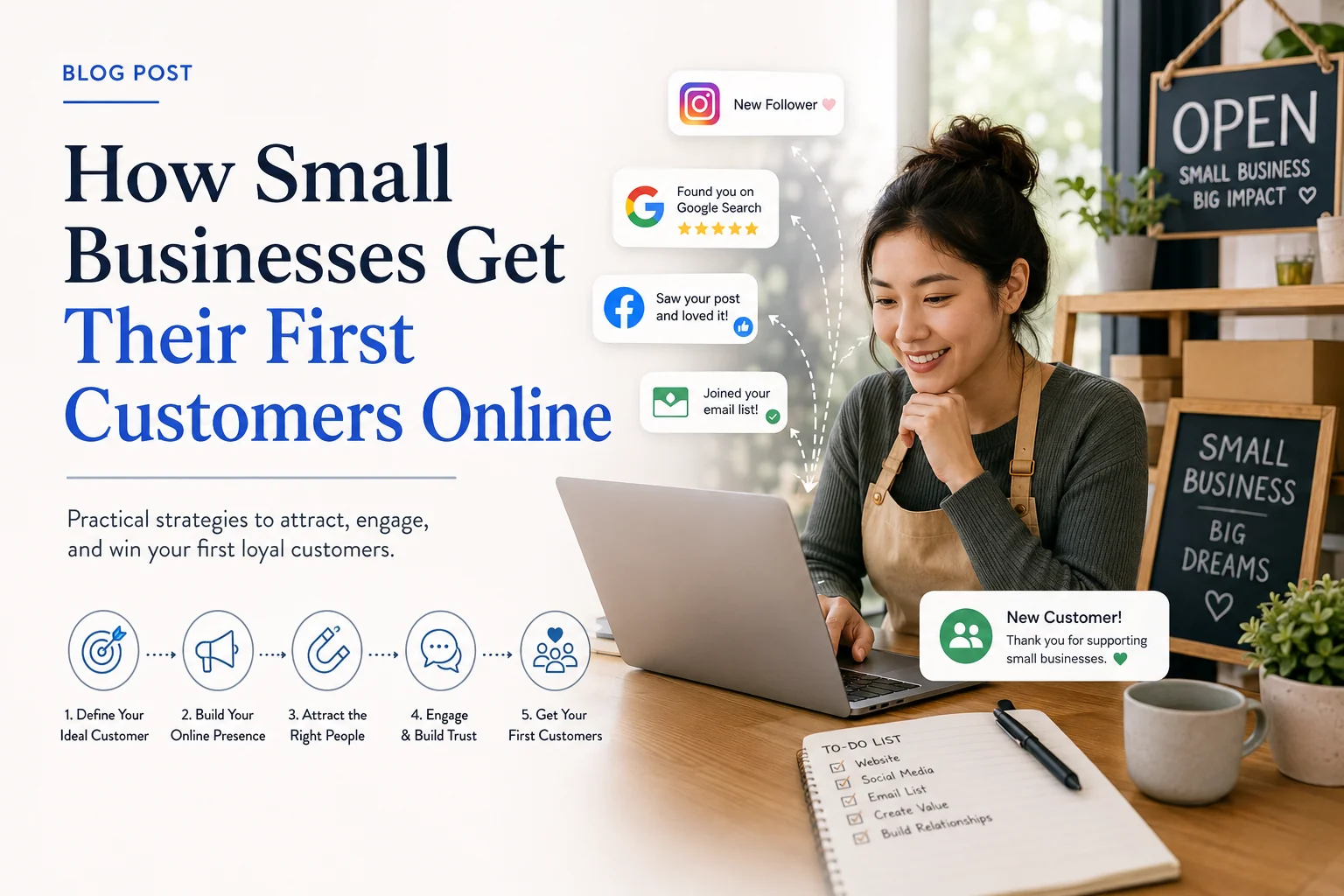
How Small Businesses Get Their First Customers Online
Getting your first customer online feels like it should be simple. You have a website. You have a service. And yet the phone stays quiet.
Most owners try to fix that quiet by doing more. More social platforms, more blog posts, more ads. It feels productive, and it usually produces a great deal of activity and almost no customers. Here is what actually works when you are starting from zero, in the order that matters.
What You Need Before You Start
Before any marketing makes sense, you need one thing in place: a destination worth sending people to.
That means a website that loads in under three seconds, explains what you do in plain language, and tells visitors exactly what to do next. If your site takes six seconds to appear or your homepage opens with something like "quality meets excellence," fix that first. Nothing else you do will convert until the foundation underneath it is solid.
What a working homepage actually needs
One sentence on what you do and who you do it for
A clear next step: a booking link, a contact form, or a phone number
A load time under three seconds on mobile
If a visitor lands on your site and has to work out what you sell, you have already lost them. A fast, clear site is the difference between a channel that earns its keep and one that quietly wastes your budget. Before you spend a dollar on ads or an hour on social, make sure the place you are sending people actually does its job.
Step 1: Pick One Channel and Work It Until It Produces
The most common mistake new owners make is spreading themselves across five platforms at once. They post twice on Instagram, twice on Facebook, half-set-up a Google Business Profile, and run a small ad. None of it gets traction, and they walk away concluding that marketing simply does not work for their business. The problem was never the marketing. It was the spreading.
One strong channel beats five abandoned ones, every time.
How to choose your channel
Start with where your buyers already go looking for what you do.
If you run a local service business, a plumber, a trainer, a therapist, your first channel is Google Business Profile. People type "electrician near me" into Google. They do not scroll Instagram hoping to stumble onto one. If you sell something visual or lifestyle-adjacent, Instagram or Pinterest may serve you better. And if your buyers are other professionals or businesses, LinkedIn is worth the time.
Pick one. Put real, sustained effort into it for 60 to 90 days, and actually measure what comes back. Only then decide whether to add a second.
Step 2: Show Up Where People Are Already Looking
Paid directories and organic search both run on the same simple logic: get in front of people who are already searching for what you sell, at the moment they are searching for it.
Google Business Profile (free, and genuinely worth it)
If you have a physical location or serve a local area, claim and fully complete your Google Business Profile. Add real photos, write a clear description of your services, and reply to every review you get. We build this into onboarding for every local service client, because it is consistently the fastest path to first-page visibility for location-based searches. It costs nothing, and most businesses leave it half-finished.
Your own website in search
If you want organic search traffic, your site has to answer the questions your buyers are actually typing into Google. In practice that means a dedicated page for each service you offer, written in plain language, with the search term in the headline. "Custom cakes Austin" or "HVAC repair Chicago" is what people type. If your homepage is the only page on your site and it leads with "Welcome to our business," you have given Google nothing to rank.
Step 3: Ask for a Review After Every Good Job
In person, word of mouth scales slowly, one conversation at a time. Online, a review is word of mouth that keeps working indefinitely. And people are reading them: only 4 percent of consumers say they never read online reviews, and 83 percent read them on Google. That is the audience deciding whether to call you.
So after every positive interaction, just ask: "Would you mind leaving us a Google review? It makes a real difference for a small business." Most people will say yes when you ask them directly. Almost nobody does it on their own.
How to make review requests easy
Send a quick follow-up text or email with a direct link straight to your Google review page. Do not make anyone go searching for where to leave it. The shorter the path, the more reviews you will actually collect. Ten genuine five-star reviews will do more for your local visibility than most ad campaigns running on the same budget.
Step 4: Make the First Ask Obvious
New owners tend to bury their contact information, assume people will figure it out, or write calls to action so soft that nobody acts on them.
Your website, your social profiles, and every piece of content you put out should answer the same question without hesitation: what should I do right now if I want to hire you? We design every site around exactly that question. Button text like "Get a Quote" or "Book a Call" outperforms a vague "Learn More" every time. The ask should be visible without scrolling, specific about what happens next, and effortless to complete on a phone.
Frequently Asked Questions
How long does it take to get your first online customer?
Most small businesses see first results within 30 to 60 days when they focus on a single channel and have a website that actually works. Paid ads can speed that up. Organic search takes longer, usually three to six months before rankings settle.
Do I need to run ads to get customers online?
No. Google Business Profile, organic search, and direct review requests can bring in real customers with no ad spend at all. Ads help you move faster, but they only amplify whatever is already working. If your site does not convert, ads will just burn money more quickly.
What is the most common reason small businesses don't get customers from their website?
The site loads too slowly, the offer is not clear, or there is no obvious next step. Those three problems account for the majority of low-converting small business websites. Fix them in that order.
What should my homepage actually say?
One sentence on what you do and who you help. A short explanation of how it works. Some proof that others have used you, whether that is reviews, photos, or a client list. And a clear way to contact you or book. That is the whole page.
Is social media worth it for a new small business?
It depends entirely on where your buyers look first. For service businesses, Google beats social almost every time. For product businesses or anything visual, one well-kept social account is worth more than five neglected ones. Choose based on your buyer's behavior, not your personal preference.
If you are starting from zero and want the foundation right before you spend on marketing, we are happy to take a look at what you have and tell you honestly where to start. Get the destination working first, then the channels have something worth pointing at.
How Small Businesses Get Their First Customers Online
Getting your first customer online feels like it should be simple. You have a website. You have a service. And yet the phone stays quiet.
Most owners try to fix that quiet by doing more. More social platforms, more blog posts, more ads. It feels productive, and it usually produces a great deal of activity and almost no customers. Here is what actually works when you are starting from zero, in the order that matters.
What You Need Before You Start
Before any marketing makes sense, you need one thing in place: a destination worth sending people to.
That means a website that loads in under three seconds, explains what you do in plain language, and tells visitors exactly what to do next. If your site takes six seconds to appear or your homepage opens with something like "quality meets excellence," fix that first. Nothing else you do will convert until the foundation underneath it is solid.
What a working homepage actually needs
One sentence on what you do and who you do it for
A clear next step: a booking link, a contact form, or a phone number
A load time under three seconds on mobile
If a visitor lands on your site and has to work out what you sell, you have already lost them. A fast, clear site is the difference between a channel that earns its keep and one that quietly wastes your budget. Before you spend a dollar on ads or an hour on social, make sure the place you are sending people actually does its job.
Step 1: Pick One Channel and Work It Until It Produces
The most common mistake new owners make is spreading themselves across five platforms at once. They post twice on Instagram, twice on Facebook, half-set-up a Google Business Profile, and run a small ad. None of it gets traction, and they walk away concluding that marketing simply does not work for their business. The problem was never the marketing. It was the spreading.
One strong channel beats five abandoned ones, every time.
How to choose your channel
Start with where your buyers already go looking for what you do.
If you run a local service business, a plumber, a trainer, a therapist, your first channel is Google Business Profile. People type "electrician near me" into Google. They do not scroll Instagram hoping to stumble onto one. If you sell something visual or lifestyle-adjacent, Instagram or Pinterest may serve you better. And if your buyers are other professionals or businesses, LinkedIn is worth the time.
Pick one. Put real, sustained effort into it for 60 to 90 days, and actually measure what comes back. Only then decide whether to add a second.
Step 2: Show Up Where People Are Already Looking
Paid directories and organic search both run on the same simple logic: get in front of people who are already searching for what you sell, at the moment they are searching for it.
Google Business Profile (free, and genuinely worth it)
If you have a physical location or serve a local area, claim and fully complete your Google Business Profile. Add real photos, write a clear description of your services, and reply to every review you get. We build this into onboarding for every local service client, because it is consistently the fastest path to first-page visibility for location-based searches. It costs nothing, and most businesses leave it half-finished.
Your own website in search
If you want organic search traffic, your site has to answer the questions your buyers are actually typing into Google. In practice that means a dedicated page for each service you offer, written in plain language, with the search term in the headline. "Custom cakes Austin" or "HVAC repair Chicago" is what people type. If your homepage is the only page on your site and it leads with "Welcome to our business," you have given Google nothing to rank.
Step 3: Ask for a Review After Every Good Job
In person, word of mouth scales slowly, one conversation at a time. Online, a review is word of mouth that keeps working indefinitely. And people are reading them: only 4 percent of consumers say they never read online reviews, and 83 percent read them on Google. That is the audience deciding whether to call you.
So after every positive interaction, just ask: "Would you mind leaving us a Google review? It makes a real difference for a small business." Most people will say yes when you ask them directly. Almost nobody does it on their own.
How to make review requests easy
Send a quick follow-up text or email with a direct link straight to your Google review page. Do not make anyone go searching for where to leave it. The shorter the path, the more reviews you will actually collect. Ten genuine five-star reviews will do more for your local visibility than most ad campaigns running on the same budget.
Step 4: Make the First Ask Obvious
New owners tend to bury their contact information, assume people will figure it out, or write calls to action so soft that nobody acts on them.
Your website, your social profiles, and every piece of content you put out should answer the same question without hesitation: what should I do right now if I want to hire you? We design every site around exactly that question. Button text like "Get a Quote" or "Book a Call" outperforms a vague "Learn More" every time. The ask should be visible without scrolling, specific about what happens next, and effortless to complete on a phone.
Frequently Asked Questions
How long does it take to get your first online customer?
Most small businesses see first results within 30 to 60 days when they focus on a single channel and have a website that actually works. Paid ads can speed that up. Organic search takes longer, usually three to six months before rankings settle.
Do I need to run ads to get customers online?
No. Google Business Profile, organic search, and direct review requests can bring in real customers with no ad spend at all. Ads help you move faster, but they only amplify whatever is already working. If your site does not convert, ads will just burn money more quickly.
What is the most common reason small businesses don't get customers from their website?
The site loads too slowly, the offer is not clear, or there is no obvious next step. Those three problems account for the majority of low-converting small business websites. Fix them in that order.
What should my homepage actually say?
One sentence on what you do and who you help. A short explanation of how it works. Some proof that others have used you, whether that is reviews, photos, or a client list. And a clear way to contact you or book. That is the whole page.
Is social media worth it for a new small business?
It depends entirely on where your buyers look first. For service businesses, Google beats social almost every time. For product businesses or anything visual, one well-kept social account is worth more than five neglected ones. Choose based on your buyer's behavior, not your personal preference.
If you are starting from zero and want the foundation right before you spend on marketing, we are happy to take a look at what you have and tell you honestly where to start. Get the destination working first, then the channels have something worth pointing at.
Related Articles

Convert & Grow
Raising Your Prices Without Losing Customers: Why Your Website Makes the Difference
Jun 5, 2026
Read more →
Convert & Grow
How to Start Taking Conversion Rate Optimization Seriously on Your Small Business Website
May 25, 2026
Read more →
Convert & Grow
How Many Landing Pages Does a Small Business Website Actually Need?
May 20, 2026
Read more →