The Most Popular Web Design Aesthetics Right Now, and How to Choose One for Your Business
You have probably landed on a website and thought, I want mine to feel like that. Then you sat down to describe it to a designer and the words just would not come. You reach for something vague like clean but not boring, or professional but not stuffy, and hope they can read your mind. It happens to almost everyone, because most of us were never taught the language of visual design in the first place.
This post hands you that vocabulary. We will walk through the aesthetics that are actually winning on small business and professional service sites in 2026, what each one signals to a visitor, and a simple, honest way to choose the one that fits your business instead of the one that just happens to look good on a design inspiration feed.
The Web Design Aesthetics Winning in 2026
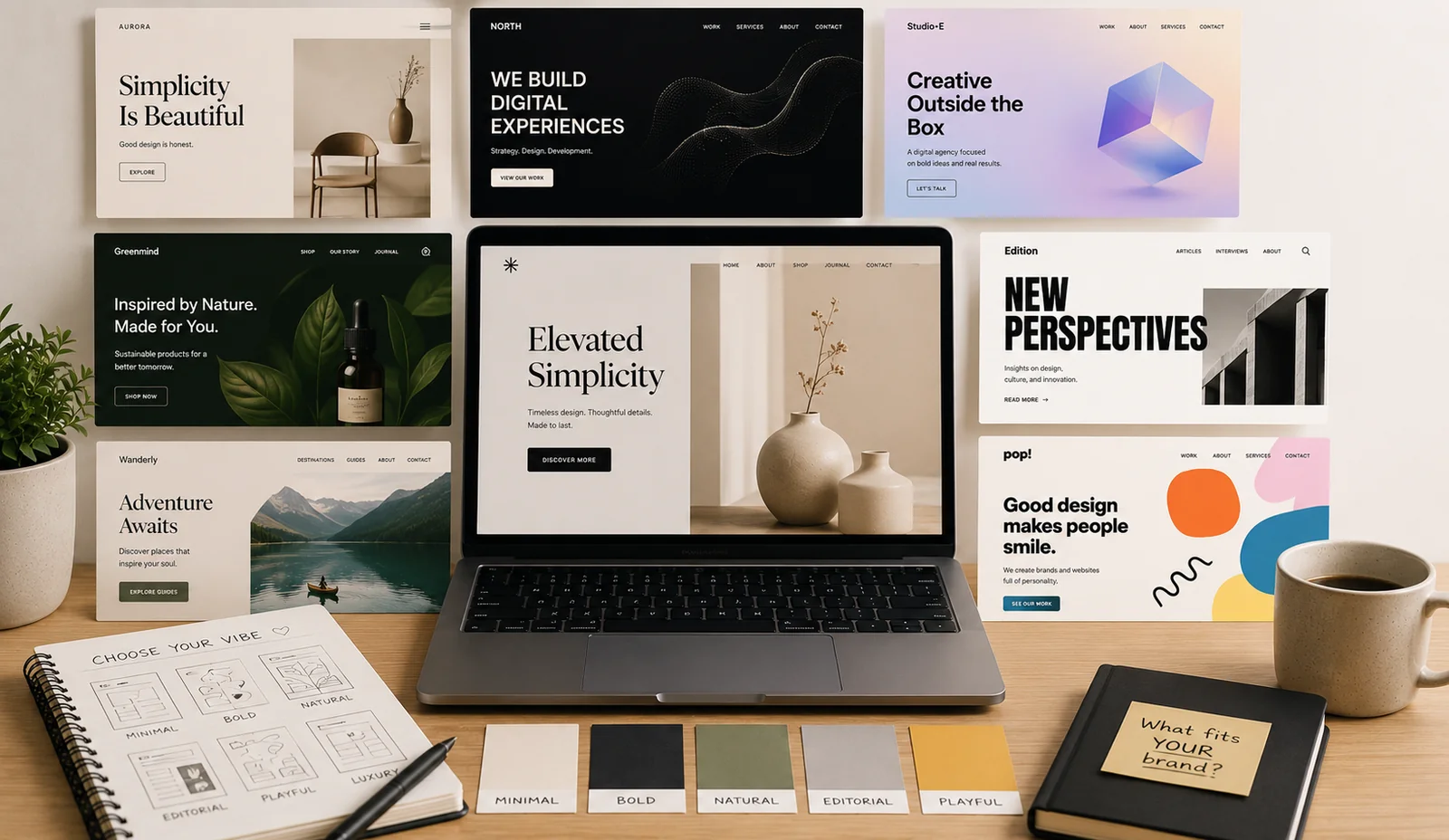
Five looks show up again and again across the small business and professional service sites being built today. Each one has its own internal logic, a reason it tends to work, and a specific way it can go wrong. Design publications like Figma and TheeDigital track these shifts every year, and the short version for 2026 is that the field has moved away from one-size-fits-all minimalism toward design with a bit more personality and warmth.
Minimal / Clean
White space does most of the heavy lifting here. The typography is simple and given room to breathe, images are used sparingly and chosen with care, and the palette rarely stretches beyond one neutral and a single accent. Minimal has been the default for the better part of a decade for good reasons. It loads fast, it ages gracefully, and it keeps a visitor's attention on your offer instead of your decoration.
The catch is that minimal is unforgiving. Done without intention, it does not read as elegant restraint. It just reads as empty. The strongest minimal sites are quietly deliberate about every spacing and type decision, which is harder than it looks. Worth knowing too: in 2026, stark minimalism is giving way to what designers now call purposeful or warm minimalism, simplicity that still carries texture and a little personality (Digital Silk).
Works well for: consultants, attorneys, financial advisors, B2B services, and health and wellness practitioners.
Bold / Graphic
Big type, strong contrast, and a tight color palette pushed hard. This look broadcasts confidence, and it usually belongs to brands that already know exactly who they are. In 2026 it often shows up as kinetic typography, headlines that move, scale, or react as you scroll, used as the visual hero of the page rather than a label sitting quietly on top of it (Envato).
Bold is harder to pull off than minimal because there is nowhere to hide. Every choice is on full display, so weak typography or a slightly off-brand color is obvious the moment the page loads. When it works, it is genuinely memorable. When it does not, it is memorably wrong.
Works well for: creative agencies, gyms, food and beverage brands, streetwear, and entertainment.
Editorial / Magazine
Grid-driven layouts, a deliberate mix of type sizes, and a content-forward structure that feels like a well-made print publication brought online. This aesthetic shines when you genuinely have something to show, real articles, case studies, photography with depth. It falls apart the moment the layout promises more than the content can deliver, because an editorial grid wrapped around thin content just looks like empty scaffolding.
Works well for: media companies, photographers, architects, and portfolio sites with real depth.
Dark Mode / Moody
Dark backgrounds, lighter text, and accents that range from muted to neon. Handled well, it carries real atmosphere and reads as premium or technical depending on the details. Handled poorly, it strains the eyes and dates quickly.
One thing has shifted since this was purely a style choice. Dark mode is now closer to a baseline expectation than a trend. Industry surveys report that more than 80 percent of smartphone users keep at least one app in dark mode, and most people now expect the option somewhere (TheeDigital). For some brands the right answer is a fully dark identity. For others it is simply offering a dark option alongside a light one. Either way, it deserves a deliberate decision rather than an afterthought.
Works well for: tech products, agencies chasing premium clients, entertainment, and nightlife.
Warm / Organic
Earthy tones, off-whites, terracottas and sage greens, rounded type, and the occasional hand-drawn or textured element. It is the deliberate antidote to sterile corporate, and it has grown fast because people are genuinely tired of identical white-box websites. In 2026 it is leaning further into soft gradients, layered depth, and shapes that gently bend the grid rather than snapping rigidly to it, all of which reads as human and approachable (Envato).
The risk is saturation. When everyone in a niche reaches for the same warm palette, it stops feeling distinctive, and that is already starting to happen across wellness and food.
Works well for: food and beverage, wellness, boutique retail, locally rooted brands, and artisans.
What's Rising in 2026
A few newer looks are worth knowing about, even if they are not right for every business. Bento grids, modular card layouts named after Japanese lunch boxes, have spread across SaaS and portfolio sites because they make dense information feel organized and easy to scan. Glassmorphism, the frosted-glass look of translucent, blurred panels layered over a background, has matured into a more refined way to create depth without heavy borders, and it pairs naturally with dark backgrounds. And subtle motion, small micro-interactions and scroll effects, is now closer to expected than impressive on its own (Figma). Treat these as tools, not requirements. The useful question is never which trend is hottest, but which one earns its place on your specific site.
How to Choose the Right Aesthetic for Your Business
The best-looking aesthetic is still the wrong choice if it fights what your customers expect from you. Here is the framework we actually use when we help a business make this call.
Match the expectation, then push slightly past it
Every industry carries a visual baseline, a set of implicit expectations your customers bring with them before they read a single word. A family law attorney who goes full bold-graphic risks looking unserious at the exact moment trust matters most. A yoga studio that goes full corporate minimal can come across as cold and clinical. The reliable move is to meet that baseline first, then push it one degree further. Aim to look a little more considered than the average site in your space, not unrecognizably different from it.
Look at who you are not
Spend real time with your competitors' sites and ask what you want to put distance between yourself and. Aim to look clearly distinct from the rest of your niche rather than like a mirror image of it. If every competitor has settled into the same warm, organic look, a more refined editorial direction might actually stand out more than simply being warmer than the warm ones.
Be honest about your content
Aesthetics make promises that your assets then have to keep. An editorial layout with weak photography looks broken. A bold, graphic direction with no striking brand color underwhelms. Choose for the assets you actually have today, not the polished photography and brand kit you keep meaning to commission. This is part of why minimal is so common. It is the most forgiving of the bunch, and it works with modest photography and a limited palette.
Think about longevity
Chasing the trend of the moment carries a real cost. A site that looked current in 2024 can feel dated by 2027 if it is welded to one specific micro-trend. Minimal ages well. Bold and editorial age well when they are executed cleanly. Warm and organic is riding high right now, which also means it may feel oversaturated in two or three years. Dark mode is distinct enough that it tends to either become your brand identity or become a maintenance headache. None of this means avoid trends. It means choose them with your eyes open.
FAQ: Web Design Aesthetics
What is the difference between a design aesthetic and a design style?
The aesthetic is the overall feeling, what a site evokes the moment it loads. The style is the specific set of choices, the fonts, colors, and layout decisions, that add up to create that feeling. You choose the aesthetic first, and the style decisions follow from it.
Can I combine aesthetics, like minimal and warm organic?
Yes, and most strong sites do exactly that. Minimal structure carrying warm color and softer, organic type is one of the most common pairings on the web right now. The trick is to let one aesthetic clearly lead and the other support it. When you try to give two strong aesthetics equal weight, you usually end up with visual noise instead of a point of view.
How do I know if my current aesthetic is hurting me?
If your site looks noticeably out of step with the serious competitors in your space, that is worth a hard look. And if visitors bounce quickly or rarely make it past the homepage, the aesthetic might be creating friction. Your page speed, your copy, and your navigation can all do the same thing, so isolate one variable at a time before you put the blame on the design.
Do web design aesthetics affect SEO?
Not directly. What does affect rankings is how the site is built underneath the look, page speed, clean code, and sensible structure. Google's Core Web Vitals measure exactly this kind of page experience and feed into how you rank. A beautiful site sitting on a bloated theme can quietly hurt your rankings, while a simpler site on clean, fast code helps them. The aesthetic you choose matters far less than the engineering it sits on.
Can I change my aesthetic without rebuilding the whole site?
It depends entirely on how the site was built. On most template-based platforms, a real aesthetic change means rebuilding from scratch, because the template is structural and not just skin-deep. On a custom-built site, and especially one built in Framer, the change is far more surgical. You can rework typography, color, and layout without tearing out the foundation underneath. We build in Framer for exactly this reason. It keeps a site flexible as the brand behind it grows and shifts.
Choosing Is Only Half of It
Picking an aesthetic you love is the starting line. What turns it into a site that actually earns its keep is the build, how fast it loads, how it holds up on a phone, and whether the copy and layout quietly guide a real person toward a decision. The prettiest design in the world still fails if it takes five seconds to load or buries the one thing you want a visitor to do.
That is the part we care most about. If you want a site that looks right and performs, InHaus builds custom websites, tuned for speed and built to convert. Reach out for a free audit and we will tell you honestly what makes sense for your business, even if that turns out to be a few focused fixes rather than a full rebuild.
The Most Popular Web Design Aesthetics Right Now, and How to Choose One for Your Business
You have probably landed on a website and thought, I want mine to feel like that. Then you sat down to describe it to a designer and the words just would not come. You reach for something vague like clean but not boring, or professional but not stuffy, and hope they can read your mind. It happens to almost everyone, because most of us were never taught the language of visual design in the first place.
This post hands you that vocabulary. We will walk through the aesthetics that are actually winning on small business and professional service sites in 2026, what each one signals to a visitor, and a simple, honest way to choose the one that fits your business instead of the one that just happens to look good on a design inspiration feed.
The Web Design Aesthetics Winning in 2026
Five looks show up again and again across the small business and professional service sites being built today. Each one has its own internal logic, a reason it tends to work, and a specific way it can go wrong. Design publications like Figma and TheeDigital track these shifts every year, and the short version for 2026 is that the field has moved away from one-size-fits-all minimalism toward design with a bit more personality and warmth.
Minimal / Clean
White space does most of the heavy lifting here. The typography is simple and given room to breathe, images are used sparingly and chosen with care, and the palette rarely stretches beyond one neutral and a single accent. Minimal has been the default for the better part of a decade for good reasons. It loads fast, it ages gracefully, and it keeps a visitor's attention on your offer instead of your decoration.
The catch is that minimal is unforgiving. Done without intention, it does not read as elegant restraint. It just reads as empty. The strongest minimal sites are quietly deliberate about every spacing and type decision, which is harder than it looks. Worth knowing too: in 2026, stark minimalism is giving way to what designers now call purposeful or warm minimalism, simplicity that still carries texture and a little personality (Digital Silk).
Works well for: consultants, attorneys, financial advisors, B2B services, and health and wellness practitioners.
Bold / Graphic
Big type, strong contrast, and a tight color palette pushed hard. This look broadcasts confidence, and it usually belongs to brands that already know exactly who they are. In 2026 it often shows up as kinetic typography, headlines that move, scale, or react as you scroll, used as the visual hero of the page rather than a label sitting quietly on top of it (Envato).
Bold is harder to pull off than minimal because there is nowhere to hide. Every choice is on full display, so weak typography or a slightly off-brand color is obvious the moment the page loads. When it works, it is genuinely memorable. When it does not, it is memorably wrong.
Works well for: creative agencies, gyms, food and beverage brands, streetwear, and entertainment.
Editorial / Magazine
Grid-driven layouts, a deliberate mix of type sizes, and a content-forward structure that feels like a well-made print publication brought online. This aesthetic shines when you genuinely have something to show, real articles, case studies, photography with depth. It falls apart the moment the layout promises more than the content can deliver, because an editorial grid wrapped around thin content just looks like empty scaffolding.
Works well for: media companies, photographers, architects, and portfolio sites with real depth.
Dark Mode / Moody
Dark backgrounds, lighter text, and accents that range from muted to neon. Handled well, it carries real atmosphere and reads as premium or technical depending on the details. Handled poorly, it strains the eyes and dates quickly.
One thing has shifted since this was purely a style choice. Dark mode is now closer to a baseline expectation than a trend. Industry surveys report that more than 80 percent of smartphone users keep at least one app in dark mode, and most people now expect the option somewhere (TheeDigital). For some brands the right answer is a fully dark identity. For others it is simply offering a dark option alongside a light one. Either way, it deserves a deliberate decision rather than an afterthought.
Works well for: tech products, agencies chasing premium clients, entertainment, and nightlife.
Warm / Organic
Earthy tones, off-whites, terracottas and sage greens, rounded type, and the occasional hand-drawn or textured element. It is the deliberate antidote to sterile corporate, and it has grown fast because people are genuinely tired of identical white-box websites. In 2026 it is leaning further into soft gradients, layered depth, and shapes that gently bend the grid rather than snapping rigidly to it, all of which reads as human and approachable (Envato).
The risk is saturation. When everyone in a niche reaches for the same warm palette, it stops feeling distinctive, and that is already starting to happen across wellness and food.
Works well for: food and beverage, wellness, boutique retail, locally rooted brands, and artisans.
What's Rising in 2026
A few newer looks are worth knowing about, even if they are not right for every business. Bento grids, modular card layouts named after Japanese lunch boxes, have spread across SaaS and portfolio sites because they make dense information feel organized and easy to scan. Glassmorphism, the frosted-glass look of translucent, blurred panels layered over a background, has matured into a more refined way to create depth without heavy borders, and it pairs naturally with dark backgrounds. And subtle motion, small micro-interactions and scroll effects, is now closer to expected than impressive on its own (Figma). Treat these as tools, not requirements. The useful question is never which trend is hottest, but which one earns its place on your specific site.
How to Choose the Right Aesthetic for Your Business
The best-looking aesthetic is still the wrong choice if it fights what your customers expect from you. Here is the framework we actually use when we help a business make this call.
Match the expectation, then push slightly past it
Every industry carries a visual baseline, a set of implicit expectations your customers bring with them before they read a single word. A family law attorney who goes full bold-graphic risks looking unserious at the exact moment trust matters most. A yoga studio that goes full corporate minimal can come across as cold and clinical. The reliable move is to meet that baseline first, then push it one degree further. Aim to look a little more considered than the average site in your space, not unrecognizably different from it.
Look at who you are not
Spend real time with your competitors' sites and ask what you want to put distance between yourself and. Aim to look clearly distinct from the rest of your niche rather than like a mirror image of it. If every competitor has settled into the same warm, organic look, a more refined editorial direction might actually stand out more than simply being warmer than the warm ones.
Be honest about your content
Aesthetics make promises that your assets then have to keep. An editorial layout with weak photography looks broken. A bold, graphic direction with no striking brand color underwhelms. Choose for the assets you actually have today, not the polished photography and brand kit you keep meaning to commission. This is part of why minimal is so common. It is the most forgiving of the bunch, and it works with modest photography and a limited palette.
Think about longevity
Chasing the trend of the moment carries a real cost. A site that looked current in 2024 can feel dated by 2027 if it is welded to one specific micro-trend. Minimal ages well. Bold and editorial age well when they are executed cleanly. Warm and organic is riding high right now, which also means it may feel oversaturated in two or three years. Dark mode is distinct enough that it tends to either become your brand identity or become a maintenance headache. None of this means avoid trends. It means choose them with your eyes open.
FAQ: Web Design Aesthetics
What is the difference between a design aesthetic and a design style?
The aesthetic is the overall feeling, what a site evokes the moment it loads. The style is the specific set of choices, the fonts, colors, and layout decisions, that add up to create that feeling. You choose the aesthetic first, and the style decisions follow from it.
Can I combine aesthetics, like minimal and warm organic?
Yes, and most strong sites do exactly that. Minimal structure carrying warm color and softer, organic type is one of the most common pairings on the web right now. The trick is to let one aesthetic clearly lead and the other support it. When you try to give two strong aesthetics equal weight, you usually end up with visual noise instead of a point of view.
How do I know if my current aesthetic is hurting me?
If your site looks noticeably out of step with the serious competitors in your space, that is worth a hard look. And if visitors bounce quickly or rarely make it past the homepage, the aesthetic might be creating friction. Your page speed, your copy, and your navigation can all do the same thing, so isolate one variable at a time before you put the blame on the design.
Do web design aesthetics affect SEO?
Not directly. What does affect rankings is how the site is built underneath the look, page speed, clean code, and sensible structure. Google's Core Web Vitals measure exactly this kind of page experience and feed into how you rank. A beautiful site sitting on a bloated theme can quietly hurt your rankings, while a simpler site on clean, fast code helps them. The aesthetic you choose matters far less than the engineering it sits on.
Can I change my aesthetic without rebuilding the whole site?
It depends entirely on how the site was built. On most template-based platforms, a real aesthetic change means rebuilding from scratch, because the template is structural and not just skin-deep. On a custom-built site, and especially one built in Framer, the change is far more surgical. You can rework typography, color, and layout without tearing out the foundation underneath. We build in Framer for exactly this reason. It keeps a site flexible as the brand behind it grows and shifts.
Choosing Is Only Half of It
Picking an aesthetic you love is the starting line. What turns it into a site that actually earns its keep is the build, how fast it loads, how it holds up on a phone, and whether the copy and layout quietly guide a real person toward a decision. The prettiest design in the world still fails if it takes five seconds to load or buries the one thing you want a visitor to do.
That is the part we care most about. If you want a site that looks right and performs, InHaus builds custom websites, tuned for speed and built to convert. Reach out for a free audit and we will tell you honestly what makes sense for your business, even if that turns out to be a few focused fixes rather than a full rebuild.